Why Occupying Kharg Island Won't End Iran's Oil Revenue
Seizing Kharg Island would not cripple Iran's economy — and could trigger a far worse regional energy crisis.
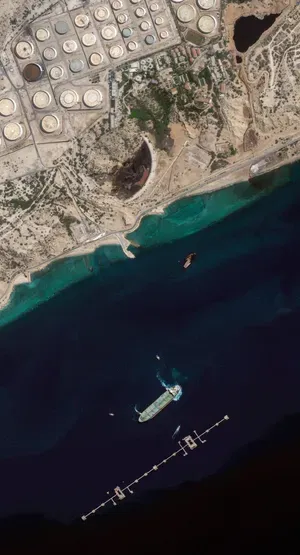
Washington's strategic calculus around Iran's Kharg Island may be built on a critical miscalculation. While U.S. officials have floated the possibility of a ground operation to seize the island — which handles roughly 95% of Iran's crude exports — the assumption that this would cripple Tehran's economy ignores years of contingency planning.
Iran has spent years preparing for exactly this scenario.
The Goreh-Jask Pipeline
At the center of Iran's contingency planning is the Goreh-Jask pipeline — a 1,000-kilometer crude oil pipeline that connects Iran's southern oil fields directly to the Jask terminal on the Gulf of Oman, completely bypassing the Strait of Hormuz.
The pipeline has a designed capacity of one million barrels per day. Iran has already conducted export shipments from the Jask terminal — including a test cargo of two million barrels in October 2024 and a second shipment in March 2026 — proving the route is operational and viable.
This means that even if Kharg Island were neutralized, Iran would retain a significant export channel outside the geographic chokepoints that the U.S. and its allies can readily control.
Shadow Export Network
Beyond the Goreh-Jask pipeline, Iran has built an extensive shadow export network developed over years of navigating sanctions. This includes ship-to-ship transfers in the Persian Gulf and Gulf of Oman, intermediaries operating through UAE ports, and onward transshipment through Malaysia and Singapore to obscure cargo origins.
The U.S. Treasury and State Department have sanctioned dozens of entities facilitating this network, yet it continues to function — providing additional redundancy that makes a single-point seizure strategy ineffective.
The Real Risk: Regional Escalation
Perhaps the most dangerous miscalculation is ignoring what Iran would do in response.
An occupation of Kharg Island could provoke Tehran into retaliatory strikes against oil infrastructure in Saudi Arabia, the UAE, and Kuwait — facilities that are arguably more vulnerable and whose disruption would send shockwaves through global energy markets far exceeding anything achieved by taking Kharg offline.
The strategic irony is stark: an operation designed to weaken Iran's economy could end up destabilizing the entire region's energy output, driving oil prices to unprecedented levels and harming the very allies the operation was meant to protect.