Qatar Cost of Living 2026: What Expats Are Actually Paying Now
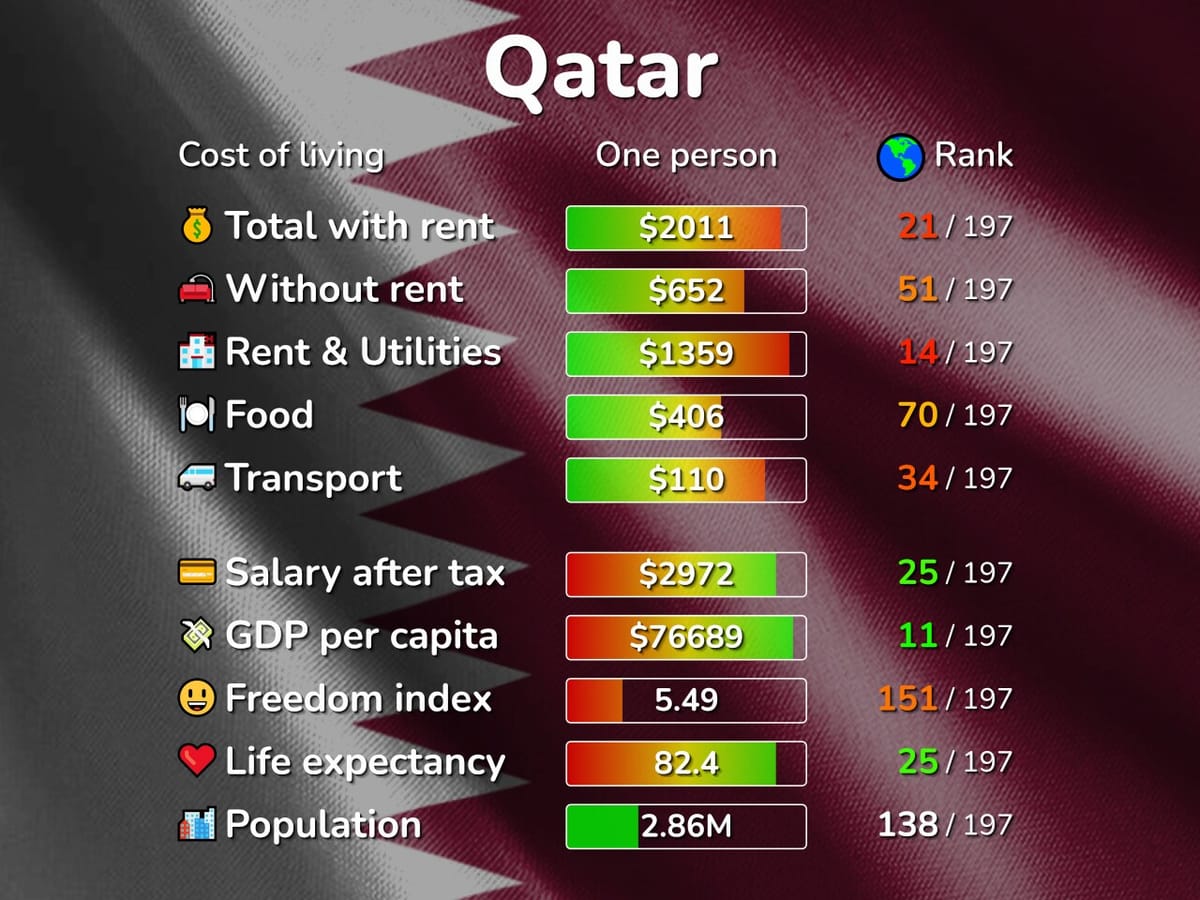
Rents Are Finally Falling — But Your Grocery Bill Isn't
Qatar's Consumer Price Index hit 110.60 points in February 2026, a 2.51 percent year-on-year jump that tells only half the story. Dig into the National Planning Council's breakdown and the picture sharpens: miscellaneous goods and services surged 21.16 percent annually, food and beverages climbed steadily, and housing costs edged upward on paper — even as actual rents in key expat districts quietly slipped. Core inflation, stripping out housing and utilities, ran at 2.91 percent, the highest in over a year. For the roughly two million expatriates who make up nearly 85 percent of Qatar's population, the question is no longer whether Doha is expensive. It is where, exactly, the money is going.
The answer depends almost entirely on where you live, whether you have children, and how much of your lifestyle you are willing to source locally. A single professional earning the average net salary of QAR 13,865 per month — with no income tax — can live well. A family of four navigating international school fees, private healthcare, and a three-bedroom apartment in West Bay is playing a very different game.
The Post-World Cup Rent Correction Has Arrived
The most significant shift in Qatar's 2026 cost landscape is happening in residential real estate. According to a ValuStrat report released in early 2026, residential rents decreased approximately 1.5 percent compared to the previous half-year, driven by a substantial wave of new housing supply flooding Lusail and The Pearl. The ValuStrat Price Index registered a marginal quarterly decline of just 0.3 percent in property values, but the rental story is more dramatic.
Qatar built furiously for the 2022 FIFA World Cup and is now absorbing the consequences: an estimated oversupply of more than 80,000 residential units. That glut is a gift to apartment-hunting expats. As of March 2026, Numbeo data shows a one-bedroom apartment in central Doha averaging QAR 7,061 per month, with options outside the city center dropping to QAR 4,725. Three-bedroom units run QAR 13,533 in premium areas and QAR 9,849 in outer districts like Al Wakra and Al Rayyan.
Lusail, the master-planned city built around the World Cup's flagship stadium, has emerged as the value play. Newer buildings with pools, gyms, and concierge services are competing aggressively for tenants, pushing asking rents below comparable units in the older Pearl-Qatar development. Villas, by contrast, have held their value better — particularly in Al Waab and West Bay Lagoon — as families with longer-term residency visas lock in freehold properties under Qatar's expanded foreign ownership rules.
A Family of Four Spends QAR 12,000 Before Rent
Strip away housing and the monthly outlay for a family of four in Doha sits at approximately QAR 12,185, according to current Numbeo and Expatistan aggregates. That figure includes groceries, transport, utilities, clothing, and basic leisure — but not school fees, not private healthcare premiums, and not the dining-out culture that Doha's social scene practically demands.
Grocery prices remain stubbornly high because Qatar imports the vast majority of its food. A litre of milk costs QAR 7.88. A kilogram of chicken breast runs QAR 26.90. A dozen eggs: QAR 9.90. Rice, the staple for a large share of the expat workforce, is QAR 8.05 per kilogram. A single person budgeting carefully can manage QAR 600 to 1,200 monthly on groceries, but families with children regularly exceed QAR 2,000.
Dining out offers a wide spectrum. A quick lunch at a cafeteria-style restaurant costs around QAR 50, while a mid-range dinner for two with drinks averages QAR 294. A McDonald's meal — the universal benchmark — is QAR 26. The February 2026 CPI data showed restaurant and hotel prices actually fell 2 percent year-on-year, one of the few categories offering genuine relief, likely driven by competition among Doha's expanding restaurant scene.
School Fees: The Line Item That Breaks Budgets
Nothing separates a comfortable expat life in Qatar from a financially strained one faster than the question of children's education. Qatar hosts 88 international schools serving over 42,500 students, and the fee range is vast enough to be almost meaningless as an average: QAR 6,000 to over QAR 80,000 per child, per year.
At the top end, ACS Doha International School charges QAR 51,309 for early years rising to QAR 80,465 for secondary students — roughly USD 22,000 annually for a single teenager. The Hamilton International School and Swiss International School (SISQ) sit in a similar bracket, with fees reaching QAR 74,000 to QAR 75,000 at the senior level. British-curriculum schools like Doha British School and the Royal Grammar School Guildford Qatar cluster in the QAR 40,000 to 60,000 range.
More affordable options exist. DPS Modern Indian School starts at QAR 6,000, and the Philippine International School Qatar charges QAR 6,230 to QAR 10,200 — viable for families on mid-range salaries. But the pattern is consistent: fees escalate sharply from primary to secondary, with one institution jumping from QAR 20,300 in early years to QAR 39,400 by graduation. All fees are reviewed annually by the Ministry of Education and Higher Education, and increases require government approval, but they do come. Factor in uniforms, textbooks, transportation, and extracurricular activities, and the true annual cost per child at a premium school can approach QAR 100,000.
Healthcare Costs Are Manageable — If Your Employer Pays
Qatar's mandatory health insurance law, enacted under Law No. 22 of 2021, requires all non-GCC expatriate residents to hold private health insurance. For most employed expats, this is a non-issue: employers are legally obligated to provide basic coverage for workers and their dependents, with fines of up to QAR 30,000 per uncovered employee enforcing compliance. The compulsory insurance rate is set at just QAR 50 per month per person.
The gap between basic coverage and actual medical costs, however, is where expats get caught. A private GP consultation runs QAR 250 to QAR 400 per visit. Inpatient procedures range from QAR 3,000 for minor surgery to QAR 25,000 for complex cases. For families wanting comprehensive international coverage — the kind that includes dental, maternity, and evacuation — premiums for a family of four typically fall between USD 6,000 and USD 11,000 per year (QAR 22,000 to QAR 40,000). Many mid-to-senior level expat packages include enhanced medical coverage, but those on local contracts or running their own businesses often find themselves underinsured.
Utilities and Transport: Where Qatar Still Delivers Value
Certain line items remain remarkably cheap by global standards. Basic utilities for an 85-square-metre apartment — electricity, water, cooling, and garbage — average QAR 338.86 per month, subsidised by the state through Kahramaa. Gasoline is QAR 2.05 per litre, less than half the European average. A single metro ride on the Doha Metro costs QAR 2, and a monthly transit pass is QAR 120.
Internet, however, is a different story. A 60 Mbps-plus broadband connection averages QAR 317.46 per month — among the highest rates in the Gulf region, reflecting Ooredoo and Vodafone Qatar's effective duopoly. Mobile plans with 10 GB or more of data run QAR 118.67 monthly. A gym membership averages QAR 531.82, and a cinema ticket costs QAR 45.
Transport costs declined 1.7 percent year-on-year in the February 2026 CPI reading, helped by stable fuel prices and the metro network's expanding ridership. For car-dependent expats — which describes the majority — a modest vehicle loan, insurance, and fuel add roughly QAR 3,000 to QAR 4,500 to monthly expenses, though many employers provide transport allowances that offset the bulk of this.
The Bottom Line: QAR 15,000 Is Comfortable, QAR 25,000 Is Safe
A single expat professional with no dependents can live well in Qatar on QAR 15,000 to QAR 20,000 per month — securing a decent one-bedroom apartment, eating out regularly, owning a car, and saving a meaningful portion of their tax-free salary. This is the bracket where Qatar's value proposition shines: comparable salaries in Dubai or Singapore come with higher rents, income taxes, or both.
For a family of four with two school-age children, the calculus shifts dramatically. A three-bedroom apartment (QAR 10,000 to QAR 13,500), two children at a mid-tier British or American school (QAR 80,000 to QAR 120,000 annually), comprehensive healthcare, groceries, a car, and basic leisure push the monthly requirement to QAR 25,000 to QAR 35,000. At premium schools and in premium districts, that figure climbs toward QAR 45,000.
The 2026 landscape offers a rare window for incoming expats: rents are softening for the first time since the World Cup era, the oversupply in Lusail and The Pearl gives tenants genuine negotiating power, and restaurant prices are falling. But grocery inflation persists, school fees only move in one direction, and the cost of connectivity remains stubbornly high. Qatar is not cheap — but for those who negotiate their packages wisely and choose their neighbourhood carefully, it remains one of the Gulf's most financially rewarding postings.