Qatar Cost of Living 2026: What Expats Are Actually Paying Now
The Rent Reality: A Market That Finally Favours Tenants
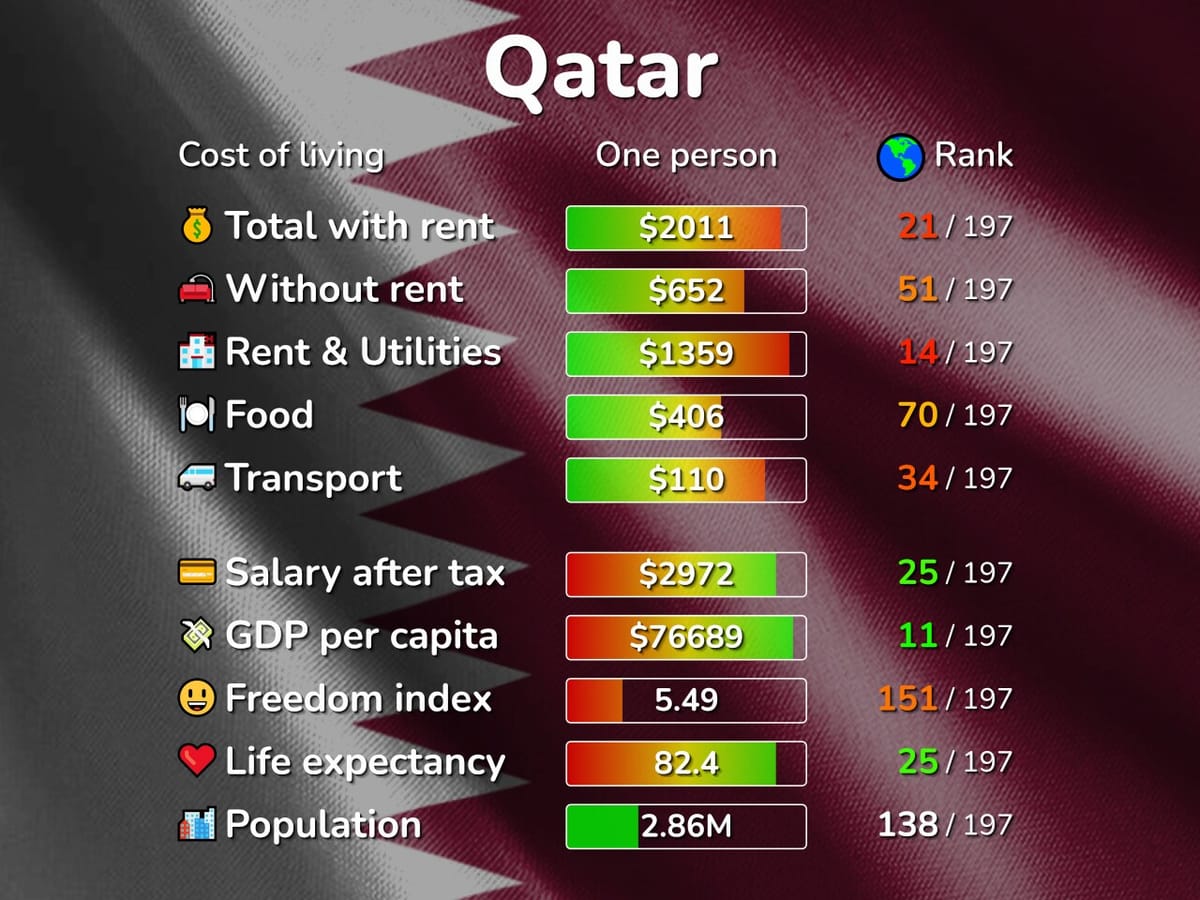
For years, Doha's rental market squeezed expat wallets with relentless price hikes fuelled by the 2022 World Cup construction boom. In 2026, the tables have turned. An estimated excess supply of more than 80,000 residential units — a legacy of that building frenzy — has pushed mid-tier apartment rents down roughly 6 percent year-on-year. The median rent across Qatar now sits at QR155 per square metre, according to market data from mid-2025, and the downward pressure has continued into early 2026.
A one-bedroom apartment in Al Wakra runs about QR4,250 per month. In established districts like Al Thumama, similar units can be found for QR4,000. The Pearl and Lusail remain premium enclaves — waterfront one-bedrooms in The Pearl still command QR7,000 to QR9,000 — but even there, landlords are offering incentives that would have been unthinkable three years ago: free months, included utilities, flexible lease terms. For families seeking two- or three-bedroom flats, the total monthly housing cost averages QR8,000 to QR13,000 depending on neighbourhood and finish level. The bottom line: 2026 is a renter's market, and expats who negotiate are finding deals their predecessors never could.
Groceries and Dining: Where the Money Actually Goes
Because Qatar imports the vast majority of its food, grocery bills hit harder than newcomers expect. The average monthly spend on food and non-alcoholic drinks is approximately QR2,100 per person — a figure that makes groceries the single largest non-housing expense for most expat households. A family of four can easily spend QR6,000 to QR8,000 per month on food alone.
The gap between smart shopping and convenience spending is enormous. Hypermarkets like Carrefour, Lulu, and Al Meera offer fresh produce and basics at prices significantly below those at speciality or neighbourhood shops. Local markets remain the best-value option for fruits, vegetables, and meats. Imported European and American brands, however, carry steep markups — sometimes double their home-country prices.
Dining out ranges from surprisingly affordable to eye-watering. A meal at an inexpensive restaurant costs QR15 to QR65. A mid-range dinner for two runs QR120 to QR390. Business lunch deals — currently advertised from QR88 for a three-course set menu — offer solid value for professionals. Qatar's foodservice market grew from USD 2.00 billion in 2025 to USD 2.18 billion in 2026, driven partly by a young, dining-out-oriented expat population that treats restaurants as a social necessity rather than a luxury.
Utilities, Transport, and the Hidden Costs
Utilities remain comparatively modest. An 85-square-metre apartment typically incurs QR300 to QR500 per month for electricity, water, cooling, and waste disposal through KAHRAMAA, Qatar's sole utilities provider. But expats should note a critical distinction: Qatari citizens often receive these services at heavily subsidised rates or entirely free for primary residences, while non-citizens pay full commercial tariffs plus a 20 percent sanitation surcharge on their water bills.
Transport costs are among the lowest in the Gulf. The Doha Metro — one of the world's fastest driverless systems — charges just QR2 per single journey, with monthly passes at QR120. Fuel is remarkably cheap by global standards: in March 2026, QatarEnergy set premium petrol at QR1.85 per litre and super at QR1.90, a slight increase from February but still a fraction of European prices. Most expats in professional roles own or lease cars, adding QR1,500 to QR3,000 monthly for vehicle payments, insurance, and maintenance.
Internet and mobile packages, often overlooked in cost calculations, run QR300 to QR500 per month for home broadband and a mobile plan — bringing total utilities and connectivity to roughly QR800 to QR1,300 monthly.
Education: The Expense That Defines Family Budgets
For expat families with children, international school fees are the single largest financial consideration — often eclipsing rent. Annual tuition in Qatar's international schools ranges from QR20,000 per year for early-stage enrolment to QR125,000 or more for IB Diploma programmes at elite institutions. The most sought-after British, American, and international curriculum schools — Doha British School, ACS Doha, Compass International — cluster in the QR50,000 to QR80,000 annual range per child.
These headline figures do not include uniforms, textbooks, transportation, and extracurricular activities, which can add QR10,000 to QR20,000 per child annually. The Ministry of Education and Higher Education reviews and regulates all school fees each year, providing some check on runaway increases. Many employers include education allowances in their compensation packages — a benefit worth negotiating hard for, as it can represent QR100,000 or more in annual value for a family with two school-age children.
Healthcare: Mandatory Insurance and Real-World Costs
Under Law No. 22 of 2021, private health insurance is mandatory for all non-Qatari residents. Basic plans start at around QR50 per month but typically exclude specialist treatments and chronic conditions. Comprehensive plans — the standard most professionals carry — average QR300 per month for individuals. For a family of four with parents in their 30s to 40s, expect annual premiums between USD 6,000 and USD 11,000 for plans covering private hospitals, specialist care, and international treatment options.
Without insurance, the costs are punishing. A private GP consultation runs QR250 to QR400 per visit. Inpatient procedures range from QR3,000 to QR25,000. Qatar's public healthcare system, managed by Hamad Medical Corporation, provides emergency care to all residents, but the quality and speed of private care make insurance a non-negotiable expense for most expat families.
The Salary Equation: What Makes Qatar Still Work
Qatar's headline cost of living ranks higher than roughly 70 percent of countries worldwide. Yet the country continues to attract professionals because of one decisive advantage: zero personal income tax. The average monthly salary stands at approximately QR16,000, but professional expats in white-collar roles typically earn QR15,000 to QR20,000, with senior positions in oil and gas reaching QR50,000 to QR70,000 or more. Every riyal is take-home pay.
The minimum wage — QR1,000 per month, with mandated employer contributions of QR500 for accommodation and QR300 for food — illustrates the vast economic spectrum within Qatar's expat community. A family of four should budget approximately QR12,200 per month excluding rent, or QR20,000 to QR25,000 all-in for a comfortable middle-class lifestyle. A single professional can live well on QR8,000 to QR13,000 monthly including rent.
With Qatar's CPI rising 2.51 percent year-on-year as of February 2026 — driven primarily by miscellaneous goods and services (up 9.67 percent) and clothing (up 2.39 percent) — inflation is ticking upward but remains manageable. The IMF projects 2.6 percent for the full year, well below the rates troubling many Western economies.
The Verdict for 2026: Timing Matters
The arithmetic of expat life in Qatar has shifted meaningfully. Rents are softer than they have been in years, driven by post-World Cup oversupply that shows no sign of rapid absorption — Qatar's residential market is valued at USD 14.36 billion in 2026 and projected to reach USD 19.93 billion by 2031, suggesting continued building despite current surpluses. Groceries and education remain stubbornly expensive, reflecting import dependence and premium demand respectively. Healthcare costs are locked in by mandatory insurance requirements.
For expats arriving in 2026, the strategic calculus is clear: negotiate housing aggressively while the market favours tenants, secure employer-sponsored education and health benefits before signing, and leverage the zero-tax advantage to build savings that would be impossible in most home countries. Qatar remains one of the world's most expensive places to live — but also one of the few where a well-structured package can turn high costs into high savings.