Qatar Airways Restores 12 Routes in April 2026 Schedule Expansion
Qatar Airways Resumes Eight Key Routes as Network Rebuild Accelerates
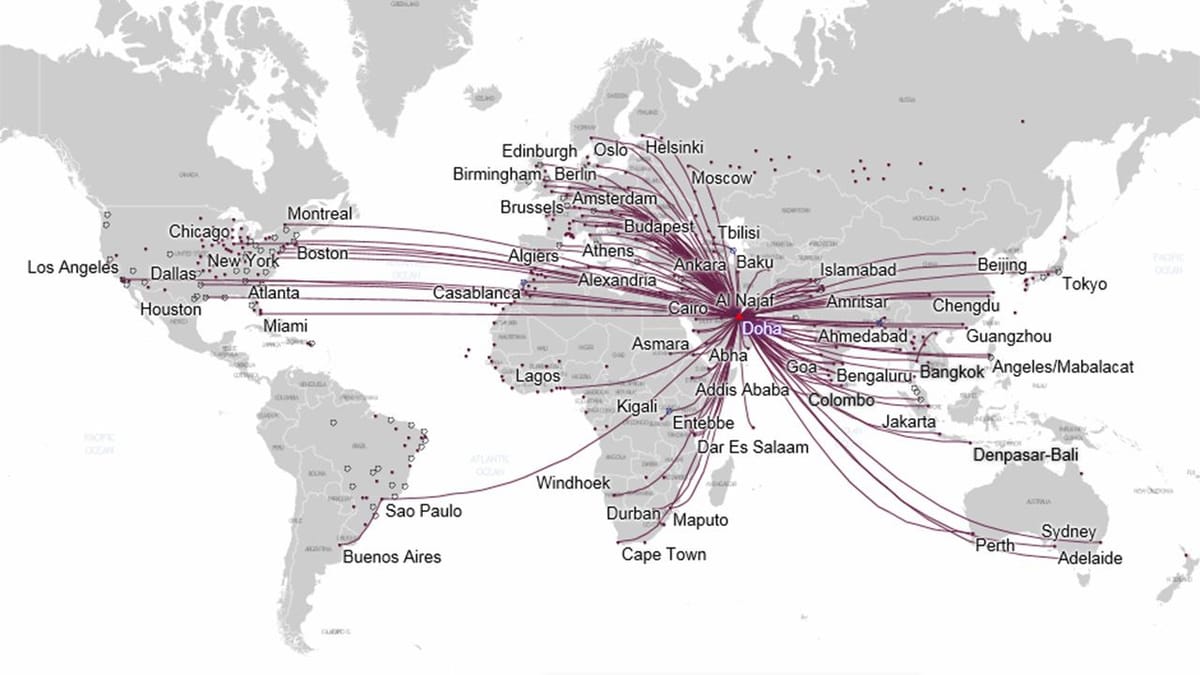
Qatar Airways announced on April 1 an expanded operational schedule extending through June 15, 2026, marking a decisive acceleration in the national carrier's network recovery. The airline, which has been operating at roughly 35% of its pre-conflict capacity since the Iran conflict erupted on February 28, is now serving more than 90 destinations through April 15 — with eight additional cities resuming from April 16, including Los Angeles, Seattle, Stockholm Arlanda, Geneva, Abidjan, Accra, AlUla, and Ha'il. The carrier's stated target of surpassing 120 destinations by mid-May signals that Doha's aviation hub, which handled 54.3 million passengers in 2025, is entering a critical phase of reconstruction.
The Phased Recovery: From 80 Daily Flights to 120 Destinations
The scale of disruption facing Qatar Airways has been without precedent in the airline's three-decade history. Following the closure of Qatari airspace in late February amid US-Israeli strikes on Iran and Tehran's retaliatory actions — including the March 18 strike on the Ras Laffan Industrial City that reduced Qatar's LNG production capacity by 17% — the carrier was forced to park approximately 43% of its fleet. Nine widebody aircraft were ferried to Teruel Airport in Spain for storage. According to Flightradar24 data, Qatar Airways became the most affected operator globally by volume of flight suspensions.
The recovery has been methodical. By late March, the airline was operating roughly 80 daily departures from Hamad International Airport through dedicated flight corridors established with the Qatar Civil Aviation Authority. The March 26 schedule update added 33 destinations, restoring frequencies to key hubs including London, Paris, New York, Singapore, Dubai, Bangkok, Mumbai, and Sydney. The April 1 revision extended coverage through June 15 and set the mid-May milestone of 120-plus destinations — still well below the pre-conflict network of 170-plus cities, but a substantial recovery nonetheless.
Strategic Route Priorities: Americas, Europe, and Africa
The eight destinations resuming from April 16 reveal clear strategic priorities under the leadership of Hamad Ali Al-Khater, who assumed the role of Group Chief Executive Officer on December 7, 2025, succeeding Engr. Badr Mohammed Al-Meer. Al-Khater, who came from his position as Chief Operating Officer at Hamad International Airport, has focused on operational excellence and hub efficiency — qualities now being tested under extraordinary circumstances.
The North American resumptions are particularly significant. Los Angeles will receive three weekly A350-1000 flights from April 17, while Seattle returns to the network in the same period. These join maintained — albeit reduced — services to New York, Toronto, and São Paulo. The European additions of Stockholm Arlanda (four weekly 787-8 flights from April 16) and Geneva further bolster connectivity to Scandinavia and Switzerland, complementing existing services to London, Paris, and other major European gateways.
The African routes carry both commercial and geopolitical weight. The Doha–Abidjan–Accra triangular service launches April 17 with twice-weekly 787-8 operations, followed by a reverse routing from April 19. Kinshasa and Luanda are pencilled in for May 16 resumption. These West and Central African connections underscore Qatar's deepening economic engagement with the continent — a strategic pillar that predates the current crisis and remains a long-term growth corridor for the airline.
The Maldives Resumption and Tourism Corridors
Separately, Qatar Airways recommenced services between Doha and Malé on April 8, operating up to five weekly flights using Airbus A350 aircraft. The Maldives route, connecting Hamad International Airport with Velana International Airport, is emblematic of the airline's approach to recovery — prioritising high-yield leisure destinations where demand has remained resilient despite the broader disruption. The Visit Maldives Corporation welcomed the resumption as a critical step in restoring the Indian Ocean archipelago's connectivity to Middle Eastern and European source markets via Doha.
The current schedule remains valid until April 15, with subsequent updates issued on a rolling basis. Passengers holding tickets for travel through June 15, 2026 can benefit from flexible rebooking policies — complimentary date changes within 14 days of the original travel date, or full refunds for unused ticket values. Qatar Airways has advised all travellers to verify flight status before departing for the airport, as schedules remain subject to change at short notice depending on airspace conditions and regulatory approvals.
Financial Pressures and the Road to Full Recovery
Behind the operational progress lie significant financial headwinds. Bloomberg reported on March 26 that Qatar Airways has contacted several aircraft lessors to potentially defer or reduce rental payments, citing the war's impact on operations. The airline has also implemented broader cost-cutting measures as the conflict continues to constrain revenue. A United Nations Development Programme study released on March 30 estimated that the war could reduce economic growth across Arab nations by $120–194 billion in GDP — a staggering figure that contextualises the pressure on Qatar's flagship carrier.
The US-Iran ceasefire announced around April 7 has brought cautious optimism, with slight increases in daily operations at Hamad International Airport. However, full unrestricted reopening of Qatari airspace has not yet been declared, and all flights continue to operate through the dedicated corridors rather than normal routing. Industry analysts note that even reaching 120 destinations by mid-May would represent only about 70% of the pre-conflict network, with full restoration unlikely before late 2026 at the earliest.
Qatar's Aviation Resilience as National Strategy
For Qatar, the reconstruction of its aviation network is not merely a commercial exercise — it is a matter of national strategic necessity. Hamad International Airport serves as the connective tissue of Qatar's post-hydrocarbon economic diversification, linking the peninsula state to global trade, tourism, and diplomatic networks. The 2017 blockade demonstrated both the vulnerability and the resilience of this model; the current crisis, though far more severe in operational impact, has drawn on institutional memory from that earlier disruption.
Al-Khater's early decision to prioritise the Airbus relationship — his first overseas trip was to Toulouse — suggests a leadership attuned to the long-term fleet requirements that will define Qatar Airways' competitive position once airspace conditions normalise. With Boeing and Airbus order books stretched years into the future, securing delivery slots now will determine whether Qatar Airways can fully restore — and eventually expand beyond — its pre-conflict network. The coming weeks, as the airline pushes toward its mid-May target of 120 destinations, will be the clearest test yet of whether Doha's aviation ambitions can withstand the region's most serious security crisis in a generation.