Qatar 2026 Expat Costs: Rent Surges 18% While Salaries Stay Flat
Doha's Rental Correction Reshapes the Expat Equation
For the first time in recent memory, expatriates in Qatar are watching rents fall rather than rise. Average apartment rents in Doha decreased 10.5 percent in January 2026, settling at approximately QAR 31,790 per month across all categories. The correction, driven primarily by an oversupply of mid-tier residential units, has pushed median rents down 6 percent year-over-year, with the ValuStrat Price Index recording only a marginal quarterly decline of 0.3 percent — signalling that the market may be entering a stabilisation phase rather than a freefall. For the roughly 2.5 million expatriates who constitute the vast majority of Qatar's population, this shift arrives at a moment when the gap between earnings and housing costs had become the defining anxiety of life in the Gulf state.
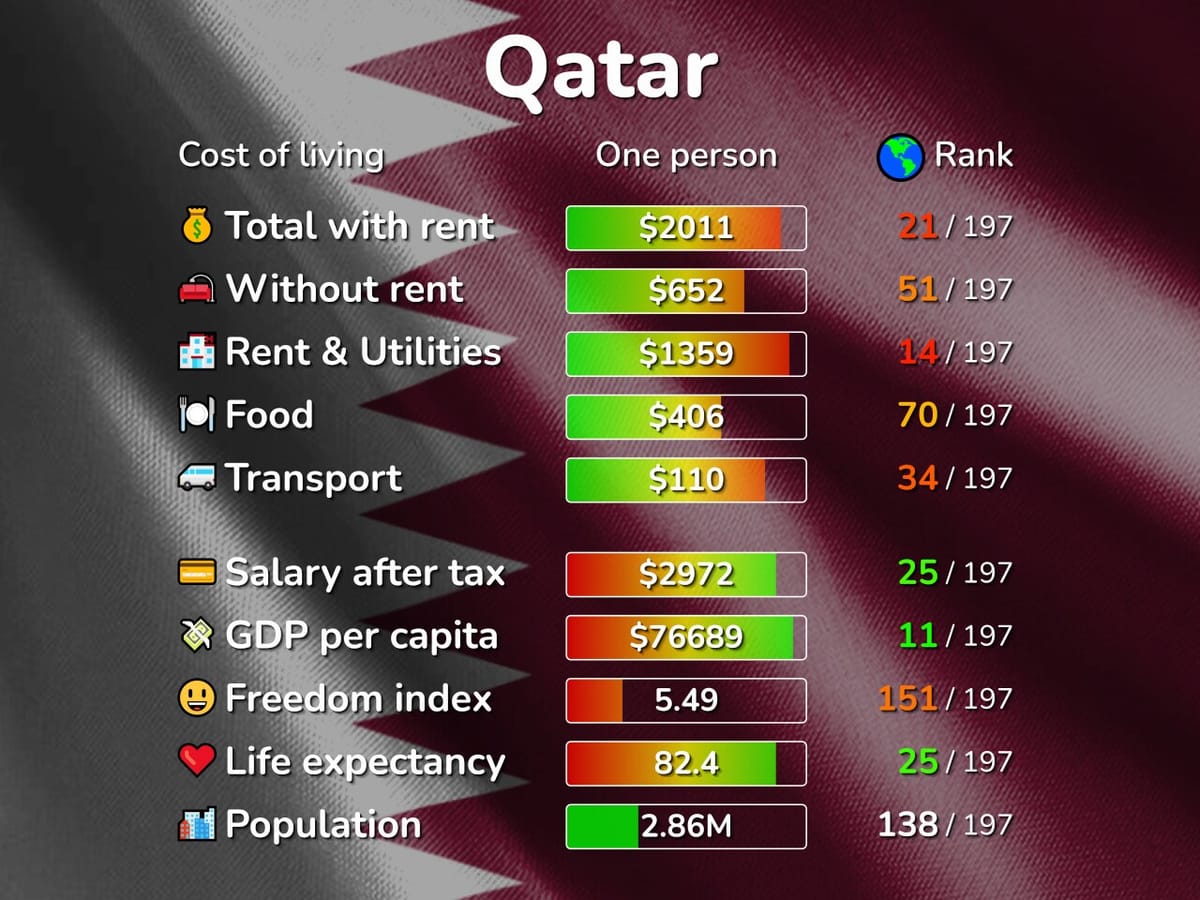
The numbers tell a story of relief, but a conditional one. A one-bedroom apartment in central Doha now commands between QAR 6,200 and QAR 9,500 per month ($1,700–$2,600), while the same unit outside the city centre ranges from QAR 4,000 to QAR 6,000. Three-bedroom family apartments in desirable areas such as West Bay and The Pearl still command QAR 11,300 to QAR 15,000 monthly. Against Numbeo's February 2026 benchmark of a QAR 13,865 average net monthly salary, even the reduced rents consume between 45 and 70 percent of a typical expat income for city-centre housing — a ratio that would be considered unsustainable by most international standards.
The Two-Speed Housing Market
Qatar's residential real estate sector, valued at USD 14.36 billion in 2026 and projected to reach USD 19.93 billion by 2031, is increasingly bifurcating along wealth lines. The villa and landed-house segment is leading growth with a projected 7.05 percent compound annual growth rate through 2031, fuelled by demand from high-net-worth expatriates and Qatari nationals seeking premium compounds in areas like Al Dafna and Lusail. February 2026 alone recorded property transactions worth USD 744 million (QAR 2.71 billion), and the Housing Index rose to 227.82 points — up from 224.19 in January.
Yet in the mid-tier apartment segment — where the majority of working expatriates live — the picture is markedly different. Oversupply has created a buyer's market for the first time since the post-World Cup adjustment period. Transaction volumes have slowed to roughly four sales per day as of January 2026, a pace that suggests caution among investors and tenants alike. For expatriate professionals on standard employment packages, this divergence is both an opportunity and a warning: rent negotiations now carry real leverage, but the premium tier remains firmly out of reach for all but senior executives and independently wealthy residents.
Salary Stagnation and the Minimum Wage Question
Qatar's zero-income-tax policy remains its most powerful recruitment tool. An expat earning QAR 15,000 monthly takes home the full amount — a structural advantage that, according to Numbeo's comparative indices, makes Qatar's cost of living 25.8 percent lower than the United States when purchasing power is factored in. Senior-level professionals command between QAR 20,000 and QAR 30,000 per month, while entry-level positions typically offer QAR 7,000 to QAR 10,000.
At the bottom of the wage scale, however, a more troubling picture emerges. Qatar's minimum wage has remained fixed at QAR 1,000 per month since its landmark introduction in 2021 — the first national minimum wage in the Gulf region. With mandatory employer allowances for housing (QAR 500) and food (QAR 300) when not provided in kind, the effective floor reaches QAR 1,800. But five years without adjustment, even against Qatar's relatively modest 2.6 percent projected inflation for 2026, means the real purchasing power of minimum-wage workers has eroded. The IMF's December 2025 consumer price data showed inflation at 1.95 percent, up from 1.38 percent in November, with regional conflict pressures creating upward risk. For the construction workers, domestic staff, and service-sector employees who earn at or near the minimum, the rental correction offers little comfort — their housing is typically employer-provided, and their disposable income remains negligible.
The Family Cost Calculus
For expatriate families — the demographic Qatar most actively courts through its education infrastructure and quality-of-life investments — the monthly arithmetic is sobering even with falling rents. A family of four faces estimated living costs of QAR 12,043 per month excluding rent, according to Numbeo's April 2026 data. Add a three-bedroom apartment outside the city centre at QAR 8,500 to QAR 13,000, and total monthly expenditure ranges from QAR 20,500 to QAR 25,000. International school tuition — a non-negotiable expense for most Western expatriate families — runs between QAR 20,000 and QAR 75,000 per year per child, effectively adding QAR 1,700 to QAR 6,250 to the monthly burden. Comprehensive health insurance costs between QAR 500 and QAR 1,500 per month.
These figures explain why dual-income expatriate households have become the norm rather than the exception. A single salary of QAR 15,000 — the upper range of Qatar's average — leaves virtually nothing after a family's basic obligations are met. The tax-free advantage, while genuine, is increasingly offset by the cost of maintaining the lifestyle standards that attracted expatriates to Doha in the first place.
Qatar's Economic Trajectory and What It Means for Expats
The broader macroeconomic context offers reasons for cautious optimism. The IMF projects Qatar's economy will grow 2.4 percent in 2026, with acceleration to 5.6 percent anticipated as the North Field East and South LNG expansion projects reach full capacity. Robust public investment, tourism growth building on World Cup-era infrastructure, and the continued diversification agenda under Qatar National Vision 2030 are expected to sustain demand for skilled expatriate labour across engineering, finance, healthcare, and education sectors.
For Doha's policymakers, the current moment presents a delicate balancing act. The rental correction makes Qatar more competitive against regional rivals — particularly Dubai, where rents have surged, and Saudi Arabia's NEOM-driven salary inflation. But the frozen minimum wage, rising education costs, and the growing premium-versus-mid-tier divide risk creating a segmented expatriate community where only the top tier can afford the quality of life that Qatar markets to the world. The residential market's stabilisation phase, if managed well, could represent a recalibration that makes Doha genuinely affordable for the professional middle class. If mismanaged — or if inflation accelerates beyond the IMF's 2.6 percent forecast amid regional instability — the cost-of-living squeeze will continue to push mid-career professionals toward competing Gulf destinations that offer better value on paper, even without Qatar's tax advantage.
The rental correction of early 2026 is not a crisis. It is an adjustment — and for Qatar's expatriate workforce, potentially the most consequential one since the post-blockade economic recalibration of 2018. How Doha responds, particularly on wages and housing policy, will determine whether the country's human capital advantage endures into the next decade.