Israel and Somaliland: The Red Sea Gambit
Israel's recognition of Somaliland is not a humanitarian gesture — it is a calculated Red Sea strategy rooted in decades of peripheral doctrine, aimed at securing a military foothold near the Bab al-Mandab Strait.
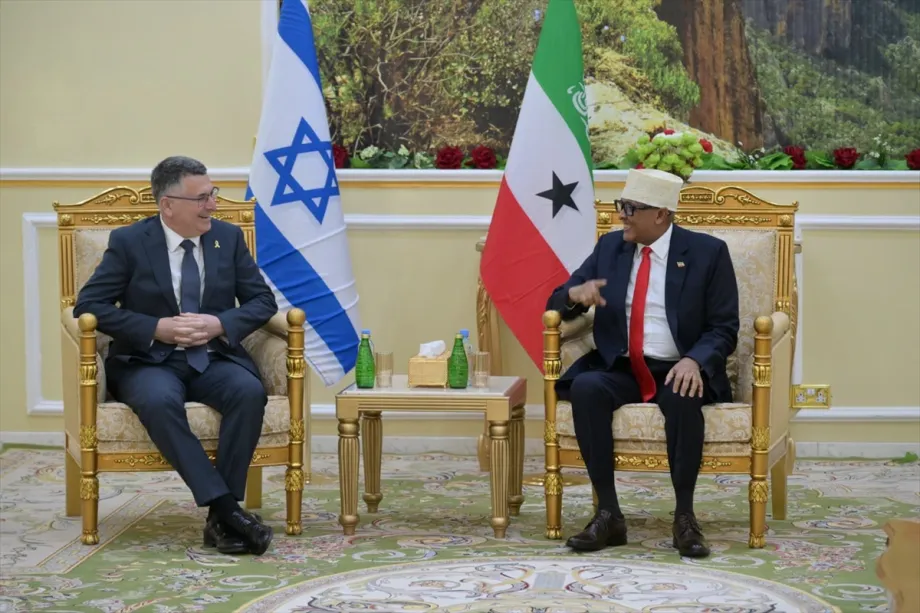
On December 26, 2025, Benjamin Netanyahu signed a joint declaration with Somaliland President Abdullahi Irro, making Israel the first UN member state to formally recognise the self-declared Republic of Somaliland. Netanyahu framed the deal as being "in the spirit of the Abraham Accords." Within days, Israeli Foreign Minister Gideon Sa'ar flew to Hargeisa — the first visit by a senior Israeli official — and confirmed that ambassadors would be exchanged. The deal was not humanitarian. It was strategic.
Somaliland sits at the intersection of the Gulf of Aden and the Bab al-Mandab Strait — the 20-mile chokepoint through which 30 percent of global container traffic flows. Its Port of Berbera, operated by UAE-owned DP World since 2016, is one of the most strategically located harbours in the Horn of Africa. For Israel, which watched its southern port of Eilat shut down under Houthi attack in July 2025, a military foothold near the Bab al-Mandab is not a gesture of solidarity with a neglected breakaway state. It is a second front in the Red Sea war — this time with Berbera as the base.
The Israeli Institute for National Security Studies was explicit: Somaliland's territory could serve as "a forward base" for intelligence monitoring of the Houthis and "a platform for direct operations" against them. Using Berbera's airstrip would reduce Israeli Air Force flying distance to Yemen by more than two-thirds. In January 2026, a Somaliland Foreign Ministry official confirmed that discussions on establishing an Israeli military base were actively underway — before her government issued a formal denial. The Foreign Minister then told reporters there were "no limits" to cooperation. The denial and the confirmation coexist.
This is not a new doctrine. Ben-Gurion's Peripheral Doctrine, articulated in the late 1950s, was built on a simple logic: since Israel is surrounded by hostile Arab states, it must cultivate alliances with non-Arab actors on the outer ring — Iran, Turkey, Ethiopia, and non-Arab African states. In 1960, when Somaliland briefly declared independence before merging with Somalia, Israel was among the first states to recognise it. Mossad spent years cultivating quiet relationships in Hargeisa. The December 2025 recognition was decades in preparation.
The Port of Berbera adds a further dimension. DP World — the Dubai state logistics arm — holds a 51 percent stake, with Somaliland at 30 percent and Ethiopia at 19 percent. Ethiopia, the most populous landlocked nation on earth, has been entirely dependent on Djibouti's port since Eritrea's secession in 1993. In January 2024, Addis Ababa signed a memorandum of understanding with Hargeisa granting Ethiopia a 20-kilometre coastal lease near Zeila. The convergence of Israeli security doctrine, Emirati capital, and Ethiopian trade dependency around a single port in a region earning $348 per capita annually is not coincidental. It is a coalition being assembled around a vulnerable state that has spent 34 years seeking international recognition at any price.
The reaction from the Arab and Muslim world was immediate, unanimous — and largely ineffective. The Arab League Secretary-General called the recognition "a clear violation of international law." Twenty-one Arab, Islamic, and African countries plus the OIC issued a joint condemnation. At the UN Security Council, 14 of 15 members opposed the move. The United States stood alone in its defence. Somalia's President Hassan Sheikh Mohamud accused Somaliland of accepting three conditions: Palestinian resettlement from Gaza, a military base, and entry into the Abraham Accords. Somaliland denies all three. The Houthis have declared any Israeli presence on Somaliland soil a legitimate military target.
The deeper danger is structural. Israel is not breaking the rules of regional geopolitics — it is rewriting them, methodically. The Abraham Accords peeled the UAE, Bahrain, Sudan, and Morocco out of collective Arab solidarity through bilateral incentives. The Somaliland recognition follows the same architecture: identify a state desperate for recognition, exploit its vulnerability, and embed Israeli strategic interests in exchange. Netanyahu has already pledged to advocate for Somaliland's inclusion in the Abraham Accords with President Trump. The circle closes.
For Somalia, the threat is existential — its territorial integrity challenged by a deal it had no part in. For the wider region, Berbera under Israeli intelligence oversight would give Tel Aviv leverage over shipping lanes that Egypt, Saudi Arabia, Sudan, and Yemen all depend on. For the Arab League and OIC, it is what the Middle East Monitor called "a post-mortem of Arab strategic impotence" — the gap between rhetorical solidarity and actionable consequence made visible in a ceremony in Hargeisa.
The port of Berbera processes 500,000 shipping containers annually. It sits 300 kilometres from Houthi-controlled Hodeidah. Israel's port of Eilat has been closed for months. The math is not complicated.